All Chemistry Paper II papers
CSS past paper
CSS Chemistry Paper II Past Paper 2026
CSS Chemistry Paper II 2026 carries 100 marks over 3 hours. It has 7 questions.
- Marks
- 100
- Time
- 3 hours
- Questions
- 7
How to attempt: Attempt ONLY FOUR questions from PART-II. ALL questions carry EQUAL marks.
Questions
Question 1 (Part I) is the paper's MCQs, which are not reproduced here.
- Q. 2
- (a)How the Resonance Effect plays a significant role to conclude the basic and acidic strengths of molecules. Discuss with relevant examples.(12)
- (b)How the Hyperconjugation alters the properties of molecules? Discuss.(8)
- Q. 3
- (a)Outline the following reactions of alkenes with suitable examples. (4 each)(16)
- (i)Hydrohalogenation
- (ii)Hydration
- (iii)Epoxidation
- (iv)Free-radical Polymerization
- (b)Although the halogens are deactivator for electrophillic aromatic substitution but still they are ortho and para directors. Explain.(4)
- Q. 4
- (a)How primary, secondary and tertiary amines can be differentiated by the Hinsberg’s method?(9)
- (b)Ethanol is the only primary alcohol which gives a positive iodoform test. Outline the mechanism of this reaction.(6)
- (c)Phenol is converted to salicylaldehyde by the famous Reimer-Tiemann reaction. Draw the mechanism of this reaction.(5)
- Q. 5
- (a)Discuss various classes of compounds which do not have any chiral carbon atoms but still they show chirality.(9)
- (b)Why 1,2- and 1-3-methylcyclohexanecarboxylic acid are optically active but 1-4-methylcyclohexanecarboxylic acid is not? Elaborate.(5)
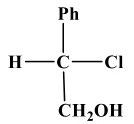
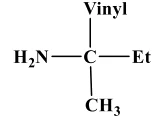
- (c)Allocate the priority to various groups with the help of sequence rules and then assign R or S configuration (whichever is applicable) to the following molecules.(6)
- (i)
- (ii)
- Q. 6
- (a)Elucidate a structure that is consistent with each set of H-NMR data.(10)
- (i): δ 10.1 (1H, br s), 7.75 (1H, d, = 16 Hz), 7.13 (1H, dd, = 2.1, 8.1 Hz), 7.08 (1H, d, = 2.1 Hz), 6.89 (1H, d, = 8.1 Hz), 6.36 (1H, d, =16 Hz), 3.92 (3H, s) and 3.87 (3H, s).
- (ii): δ 7.71 (1H, d, = 16 Hz), 6.76 (2H, s), 6.38 (1H, d, = 16 Hz), and 3. 78 (3H, s).
- (b)Sketch out the mass fragmentation pattern in molecule.(6)
- (c)How can you distinguish between following pairs of compounds with the help of IR spectroscopy? and(4)
- Q. 7
- (a)Discuss the chemistry of fatty acids and glyceryl trialkanoates in detail.(10)
- (b)How the numbering in steroids is carried out? Discuss the reactions and biological functions of cholesterol.(10)
- Q. 8
- (a)Draw a flow-sheet diagram and elaborate the manufacturing and processing of paper in the paper industry.(16)
- (b)Elaborate why the fertilizers are necessary for proper plant growth.(4)
- Part-II is to be attempted on the separate Answer Book.
- Attempt ONLY FOUR questions from PART-II. ALL questions carry EQUAL marks.
- All the parts (if any) of each Question must be attempted at one place instead of at different places.
- Write Q. No. in the Answer Book in accordance with Q. No. in the Q.Paper.
- No Page/Space be left blank between the answers. All the blank pages of Answer Book must be crossed.
- Extra attempt of any question or any part of the question will not be considered.
- Use of Calculator is allowed.