Skip to content
All Chemistry Paper II papers

CSS past paper

CSS Chemistry Paper II Past Paper 2017

CSS Chemistry Paper II 2017 carries 100 marks over 3 hours. It has 7 questions.

Marks
100
Time
3 hours
Questions
7

How to attempt: Attempt ONLY FOUR questions from PART-II. ALL questions carry EQUAL marks.

Questions

Question 1 (Part I) is the paper's MCQs, which are not reproduced here.

  1. Q. 2
    Write brief notes on the following (2 each)
    (20)
    • (i)
      Covalent Bond
    • (ii)
      Hybridization
    • (iii)
      Isomerism
    • (iv)
      Monosaccharides
    • (v)
      Triglycerides
    • (vi)
      Electronegativity
    • (vii)
      The Inductive Effect
    • (viii)
      Chemical Shift
    • (ix)
      Stereoselectivity
    • (x)
      Fertilizers
  2. Q. 3
    • (a)
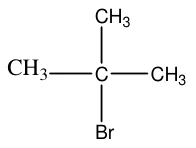
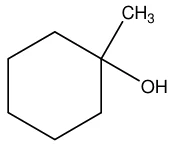
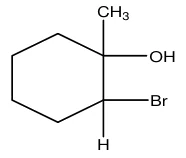
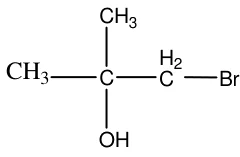
      Give the method of synthesis of the following compounds from an appropriate alkene of your choice with reagents.
      (12)
      • (i)
        tert-Butyl bromide: a central C bearing CH3 above, CH3 left, CH3 right and Br below.
      • (ii)
        1-Methylcyclohexanol: a cyclohexane ring with CH3 and OH on the same carbon.
      • (iii)
        A cyclohexane ring in which one carbon bears CH3 and OH and the adjacent carbon bears Br and H (2-bromo-1-methylcyclohexanol).
      • (iv)
        CH3-C(CH3)(OH)-CH2-Br: a central C bearing CH3 above, CH3 left, OH below and a CH2-Br group to the right (1-bromo-2-methylpropan-2-ol).
      • (v)
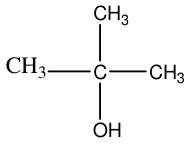
        tert-Butyl alcohol: a central C bearing CH3 above, CH3 left, CH3 right and OH below.
      • (vi)
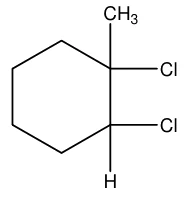
        A cyclohexane ring in which one carbon bears CH3 and Cl and the adjacent carbon bears Cl and H (1,2-dichloro-1-methylcyclohexane).
    • (b)
      Write the Major product for these Reactions.
      (8)
      • (1)
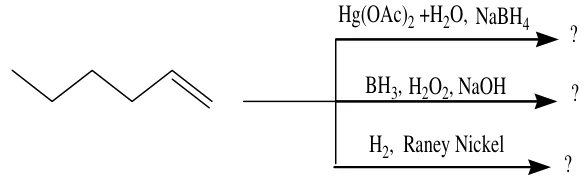
        Hex-1-ene (skeletal zigzag with a terminal C=C) branching into three arrows: Hg(OAc)2 +H2O, NaBH4 to ?; BH3, H2O2, NaOH to ?; H2, Raney Nickel to ?.
      • (2)
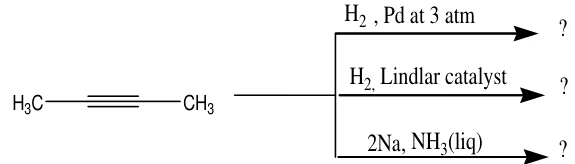
        But-2-yne (H3C-C≡C-CH3) branching into three arrows: H2, Pd at 3 atm to ?; H2, Lindlar catalyst to ?; 2Na, NH3(liq) to ?.
      • (3)
        An alkyne (triple bond, acetylene) with NaNH2 over the arrow and 1-bromobutane (skeletal, Br at the end) below it, giving ?; then H2O over and H2SO4, HgSO4 under a second arrow, giving ?.
  3. Q. 4
    • (a)
      What is aromaticity? Explain the Hückel criteria for aromaticity.
      (6)
    • (b)
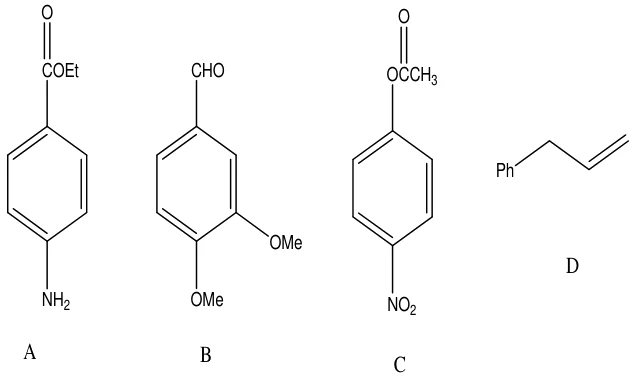
      Write names of the following compounds.
      (4)
      Four structures: A, a benzene ring with C(=O)OEt and, para to it, NH2 (ethyl 4-aminobenzoate); B, a benzene ring with CHO and OMe groups at the 3 and 4 positions (3,4-dimethoxybenzaldehyde); C, a benzene ring with OC(=O)CH3 and, para to it, NO2 (4-nitrophenyl acetate); D, Ph-CH2-CH=CH2 (allylbenzene, skeletal).
    • (c)
      Write the reaction and mechanism of Friedel Craft alkylation and acylation reaction.
      (10)
  4. Q. 5
    • (a)
      What is Grignard reagent? What are its applications? How would you prepare Grignard reagent starting from an alkyl halide of your choice.
      (8)
    • (b)
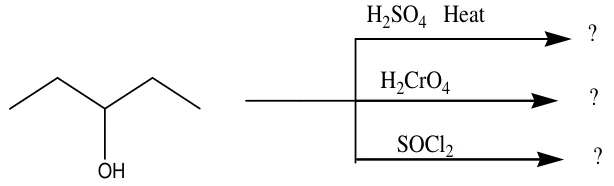
      Give the Product of the following reactions:
      (3)
      Pentan-3-ol (skeletal, OH on the middle carbon) branching into three arrows: H2SO4 Heat to ?; H2CrO4 to ?; SOCl2 to ?.
    • (c)
      Give the IUPAC nomenclature of Aldehydes and Ketones.
      (4)
    • (d)
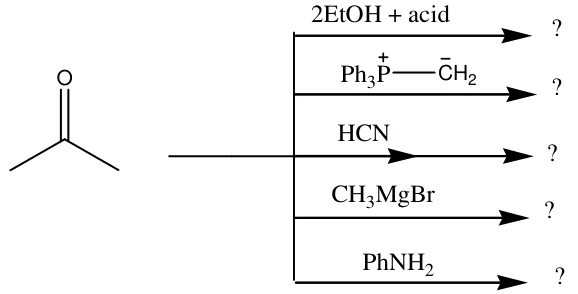
      Give the major products of the following reactions.
      (5)
      Acetone (skeletal, C=O) branching into five arrows: 2EtOH + acid to ?; the ylide Ph3P⁺-CH2⁻ to ?; HCN to ?; CH3MgBr to ?; PhNH2 to ?.
  5. Q. 6
    • (a)
      What is stereoisomerism? Give an account of different types of stereoisomerism.
      (5)
    • (b)
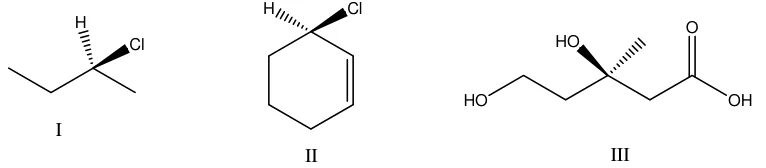
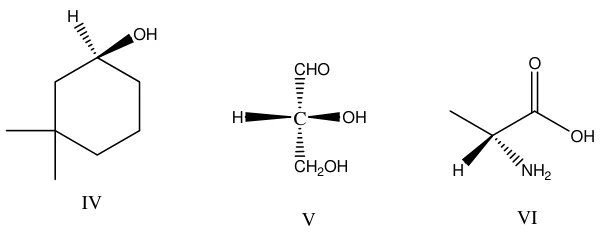
      Assign an R or S configuration to the chiral center in each molecule.
      (9)
      Structures I to III: I, a skeletal chain with a stereocentre bearing a hashed H and a wedged Cl (2-chlorobutane); II, a cyclohexene ring whose stereocentre bears a hashed H and a wedged Cl next to the C=C; III, a skeletal chain HO-CH2CH2-C(stereocentre)-CH2-COOH whose stereocentre bears a wedged OH (HO) and a hashed methyl.
      Structures IV to VI: IV, a cyclohexane with a gem-dimethyl carbon and, at the ring carbon opposite, a hashed H and a wedged OH; V, a wedge-dash cross with CHO (hashed) at the top, CH2OH (hashed) at the bottom, H (wedge) to the left and OH (wedge) to the right; VI, alanine drawn skeletally with COOH, a wedged H and a hashed NH2 on the stereocentre.
    • (c)
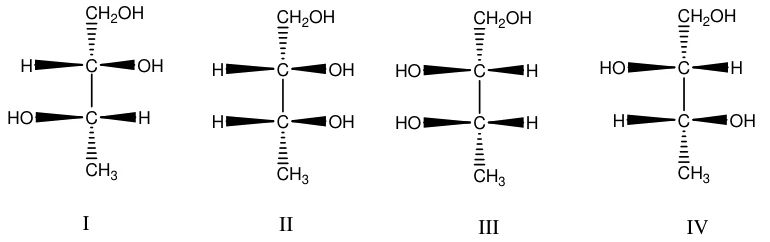
      In the following molecules identify that which are diastereomers and which are enantiomers?
      (6)
      Four wedge-dash projections, each with CH2OH at the top, CH3 at the bottom and two stereocentres: I, upper H left/OH right, lower HO left/H right; II, upper H left/OH right, lower H left/OH right; III, upper HO left/H right, lower HO left/H right; IV, upper HO left/H right, lower H left/OH right.
  6. Q. 7
    • (a)
      What is the difference between Dispersive IR Spectrometer and Fourier Transform (FT)-IR Spectrometer.
      (5)
    • (b)
      Differentiate the following on the basis of IR.
      (3)
      Three carbonyl compounds: A, CH3(CH2)7-CH=CH-CHO (an α,β-unsaturated aldehyde, printed 'CH3(CH2)7'); B, CH2=CH-(CH2)7-CHO (a non-conjugated alkenal); C, pent-3-en-2-one (skeletal, a conjugated enone).
    • (c)
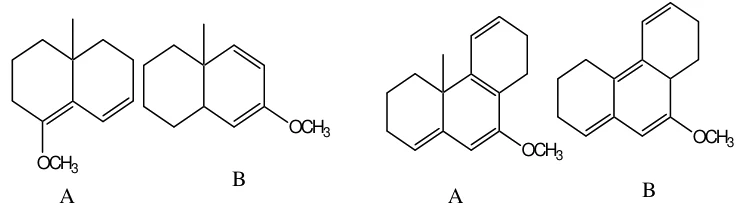
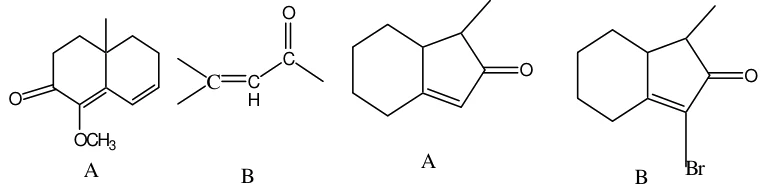
      Differentiate the following pairs of compounds on the basis of UV.
      (8)
      Two pairs of methoxy dienes: first pair, A, a methyl-decalin diene with OCH3 on a ring-fusion-adjacent alkene carbon, and B, a methyl-decalin diene with OCH3 at the end of a conjugated diene; second pair, A and B, tricyclic methoxy dienes (B with a more extended conjugated system).
      Two more pairs: A, a methyl-decalin dienone with C=O and OCH3 on the ring, and B, an acyclic enone (CH3)2C=CH-C(=O)-CH3; A, a bicyclic cyclopentenone (fused to a cyclohexane, with a methyl), and B, the same cyclopentenone with Br on the alkene carbon.
    • (d)
      Deduce the structure of the product of the given reaction from the following data.
      (4)
      Ethylene glycol (CH2-CH2 with an OH on each carbon) + butanone (CH3CH2C(=O)CH3), followed by an arrow.

      The product has

      IR: Four strong bands that appear in the range of 1200 to 1020 cm−1^{-1}

      NMR: 3 Proton triplet at 0.8ppm, 3 Proton singlet at 1.3ppm, 2 proton quartet at 1.8ppm and 4 proton multiplet at 4.0ppm

  7. Q. 8
    Write notes on any FOUR of the following: (5 each)
    (20)
    • (a)
      Reactions of Monosaccharides
    • (b)
      Biosynthesis of Cholesterol
    • (c)
      Primary structure of Polypeptides and Protein.
    • (d)
      Prostaglandins
    • (e)
      Synthesis of Peptides
  1. Part-II is to be attempted on the separate Answer Book.
  2. Attempt ONLY FOUR questions from PART-II. ALL questions carry EQUAL marks.
  3. All the parts (if any) of each Question must be attempted at one place instead of at different places.
  4. Candidate must write Q. No. in the Answer Book in accordance with Q. No. in the Q.Paper.
  5. No Page/Space be left blank between the answers. All the blank pages of Answer Book must be crossed.
  6. Extra attempt of any question or any part of the attempted question will not be considered.
  7. Use of Calculator is allowed.