All Chemistry Paper II papers
CSS past paper
CSS Chemistry Paper II Past Paper 2025
CSS Chemistry Paper II 2025 carries 100 marks over 3 hours. It has 7 questions.
- Marks
- 100
- Time
- 3 hours
- Questions
- 7
How to attempt: Attempt ONLY FOUR questions from PART-II. ALL questions carry EQUAL marks.
Questions
Question 1 (Part I) is the paper's MCQs, which are not reproduced here.
- Q. 2
- (a)Elaborate with examples that how resonance, hyperconjugation and inductive effect, can contribute towards the stability of carbocations.(10)
- (a)How ‘dipole moment’ can be measured? Indicate, among the following molecules which does not have dipole moment and why?(10)
- (i)
- (ii)
- (iii)
- (iv)
- Q. 3
- (a)How does the reaction mechanism work for the electrophilic addition of bromine to ethene? Explain the intermediate (s).(10)
- (b)Describe the IUPAC rules for naming alkenes and alkynes with appropriate examples.(10)
- Q. 4
- (a)Categorize benzene substituents, into activating and deactivating groups. Explain their influence on ortho, para and meta orientation of incoming groups in electrophilic substitution reactions.(12)
- (b)How did Kekulé propose the benzene structure, and what evidence supported his model?(8)
- Q. 5
- (a)Compare the reactivity of acid halides, anhydrides, esters, and amides toward nucleophilic substitution. What kind of products do you expect when these react with Grignard reagent (RMgX)?(10)
- (b)Explain the reaction mechanism of Williamson synthesis to prepare ethers.(5)
- (c)Discuss the acidic nature of phenols. Why picric acid () is considered strong acid?(5)
- Q. 6
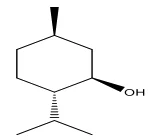
- (a)Given below is the structure of (1R, 2S, 5R) menthol. Draw the structures of all possible stereoisomers of menthol.(8)
- (b)How does Hofmann’s rule differ from Zaitsev’s rule? Explain each with suitable example.(6)
- (c)Describe the main components of a UV/Visible spectrophotometer and their functions.(6)
- Q. 7
- (a)Write a comprehensive note on primary, secondary, tertiary, and quaternary structures of proteins.(10)
- (b)Write a note on enzyme catalysis and enzyme inhibition.(10)
- Q. 8
- (a)Outline the steps of the Krebs cycle, and explain its role in cellular respiration.
- (b)Describe the environmental impact of the manufacturing industry of sugar, cement, glass, paper and fertilizers. How these industries can address environmental concerns?
- Part-II is to be attempted on the separate Answer Book.
- Attempt ONLY FOUR questions from PART-II. ALL questions carry EQUAL marks.
- All the parts (if any) of each Question must be attempted at one place instead of at different places.
- Write Q. No. in the Answer Book in accordance with Q. No. in the Q.Paper.
- No Page/Space be left blank between the answers. All the blank pages of Answer Book must be crossed.
- Extra attempt of any question or any part of the question will not be considered.
- Use of Calculator is allowed.