All Chemistry Paper II papers
CSS past paper
CSS Chemistry Paper II Past Paper 2024
CSS Chemistry Paper II 2024 carries 100 marks over 3 hours. It has 7 questions.
- Marks
- 100
- Time
- 3 hours
- Questions
- 7
How to attempt: Attempt ONLY FOUR questions from PART-II. ALL questions carry EQUAL marks.
Questions
Question 1 (Part I) is the paper's MCQs, which are not reproduced here.
- Q. 2Explain the following:
- (a)Hybridization in organic chemistry involves and orbitals only. Why? Also discuss the concept of hybridization in the context of organic compounds, providing example and explaining how it influences molecular shapes and bond angles.(8)
- (b)The process of converting tert-butyl alcohol into tert-butyl chloride, providing details on the reagents and reaction conditions involved.(6)
- (c)In contrast to reactions, reactions show relatively little nucleophile selectivity. That is, when more than one nucleophile is present in the reaction medium, reactions show only a slight tendency to discriminate between weak nucleophiles and strong nucleophiles, whereas reactions show a marked tendency to discriminate.(6)
- (a)Provide an explanation for this behavior.
- (b)Show how your answer accounts for the following:
- (i)

- (ii)

- Q. 3
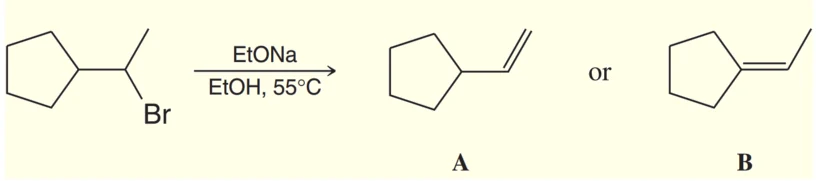
- (a)Using Zaitsev’s rule, predict which would be the major product of the following reaction. Also justify your answer.(4)
- (b)Give the equation for the following reactions along with reaction conditions:(8)
- (i)Reduction of propyl bromide
- (ii)Synthesis of acetone from propene
- (iii)Synthesis of cyclohexane from phenol
- (iv)Oxidation of ethylene in hot and cold
- (c)A compound with molecular formula has a strong IR absorption at 1730 cm. Its mass spectrum is tabulated below, and includes key peaks at m/z 44 (the base peak) and m/z 29. Propose a structure for the compound and write fragmentation equations showing how peaks having these m/z values arise.(8)
Table: Mass spectrum of an unknown compound m/z Intensity (as percent of base peak) m/z Intensity (as percent of ) 27 59.0 72 100.0 28 15.0 73 +1 4.5 29 54.0 74 +2 0.3 39 23.0 41 60.0 Recalculated to base on 42 12.0 43 79.0 44 100.0 (base) 72 73.0 73 3.3 74 0.2
- Q. 4
- (a)Answer the following: (2 marks each)(10)
- (i)Write resonance structures for the azide ion, . Explain how these resonance structures account for the fact that both bonds of the azide ion have the same length.
- (ii)Explain why cis-1,2-dichloroethene has a large dipole moment i.e 1.90 whereas trans-1,2-dichloroethene has a dipole moment equal to zero.
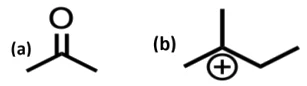
- (iii)Identify the nucleophilic center of each molecule.
- (iv)Write the structures of two chair conformations of 1-tert-butyl-1-methylcyclohexane. Which conformation is more stable? Explain your answer.
- (v)Why alkenes are more reactive than alkanes in chemical reactions.
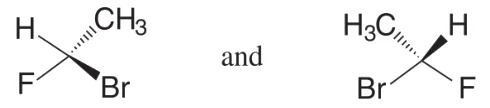
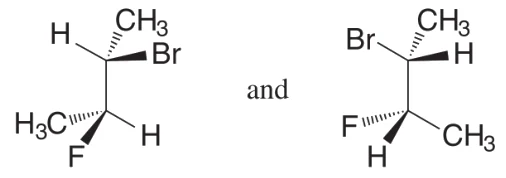
- (b)Consider the following pairs of structures. Designate each chirality center as (R) or (S) and identify the relationship between them by describing them as representing enantiomers, diastereomers, constitutional isomers, or two molecules of the same compound.(5)
- (i)
- (ii)
- (c)Write a mechanism for the following reaction. Include formal charges and curved arrows to show the movement of electrons in all steps.(5)

- Q. 5
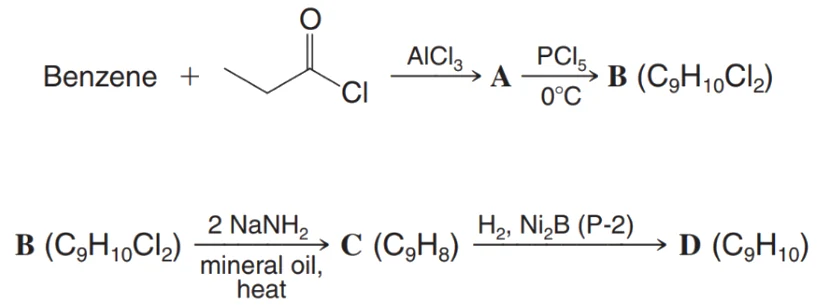
- (a)Give structures (including stereochemistry where appropriate) for compounds A–D. [Hint: The NMR spectrum of compound C consists of a multiplet at 7.20 (5H) and a singlet at 2.0 (3H).](5)
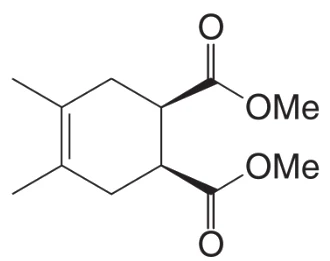
- (b)Which diene and dienophile would you employ in the synthesis of following? Give mechanism also.(5)
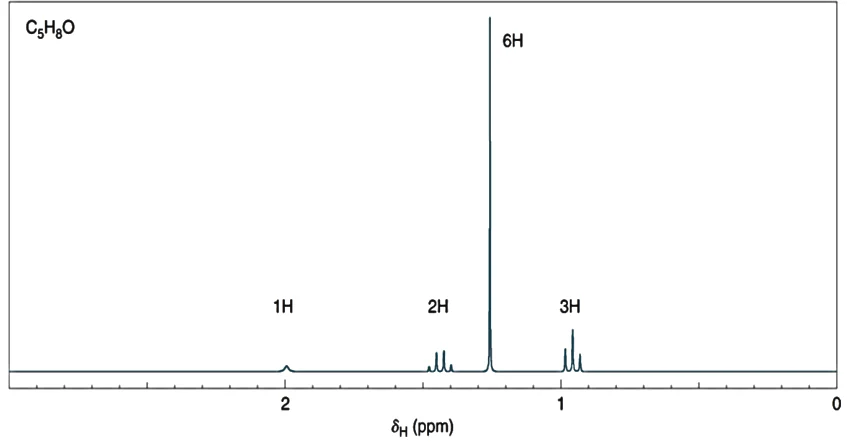
- (c)Propose a structure for an alcohol with molecular formula that has the NMR spectrum given in Figure below. Assign the chemical shifts and splitting patterns to specific aspects of the structure you propose.(5)
The spectrum is labelled C5H8O; the question text gives C5H12O.
- (d)What are the common by-products generated during sugar manufacturing process. Discuss the applicability of each by-product in perspective of Pakistan.(5)
- Q. 6
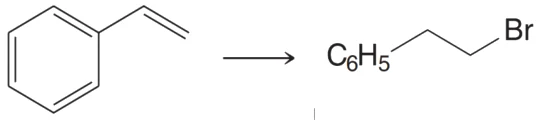
- (a)Starting with styrene, outline a synthesis of 1-bromo-2-phenylethane.(5)
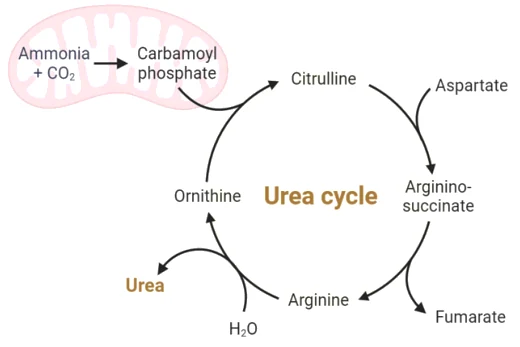
- (b)Urea cycle is illustrated in figure below. Explain the significance of the urea cycle in the context of nitrogen metabolism. How does the urea cycle prevent the toxic accumulation of ammonia in the body?(5)
- (c)Illustrate the mechanism for dehydrating an alcohol to produce an alkene, using ethanol as a specific example.(5)
- (d)What is the role of grinding and milling processes in cement manufacturing. How do they impact the fineness of the final product?(5)
- Q. 7
- (a)Compare and contrast the Lucas test and the dichromate test for alcohols. Provide a detailed explanation of the procedures, reactions involved, and the specific observations or results expected in each test. Highlight the distinguishing features that allow these tests to differentiate between primary, secondary, and tertiary alcohols.(5)
- (b)Compare the structure of saturated and unsaturated fatty acids and explain their impact on human health.(5)
- (c)Describe the process of glycolysis. Include the key intermediates, enzymes involved, and the fate of pyruvate under aerobic and anaerobic conditions.(5)
- (d)Explain the role of limestone in cement production and its impact on the chemical composition of the final product.(5)
- Q. 8
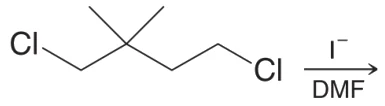
- (a)Competition experiments are those in which two reactants at the same concentration (or one reactant with two reactive sites) compete for a reagent. Predict the major product resulting from each of the following competition experiments:(8)
- (i)
- (ii)
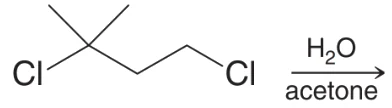
- (b)Define phospholipids and discuss their structural components. Explain how the structure of phospholipids contributes to their unique properties in biological membranes. Describe the process of phospholipid synthesis.(6)
- (c)Explain the role of enzymes in biomolecular reactions, providing examples of specific enzymatic reactions.(6)
- Part-II is to be attempted on the separate Answer Book.
- Attempt ONLY FOUR questions from PART-II. ALL questions carry EQUAL marks.
- All the parts (if any) of each Question must be attempted at one place instead of at different places.
- Write Q. No. in the Answer Book in accordance with Q. No. in the Q.Paper.
- No Page/Space be left blank between the answers. All the blank pages of Answer Book must be crossed.
- Extra attempt of any question or any part of the question will not be considered.
- Use of Calculator is allowed.