All Chemistry Paper II papers
CSS past paper
CSS Chemistry Paper II Past Paper 2023
CSS Chemistry Paper II 2023 carries 100 marks over 3 hours. It has 7 questions.
- Marks
- 100
- Time
- 3 hours
- Questions
- 7
How to attempt: Attempt ONLY FOUR questions from PART-II. ALL questions carry EQUAL marks.
Questions
Question 1 (Part I) is the paper's MCQs, which are not reproduced here.
- Q. 2(20)
- (a)Arrange the following alkenes in order of their relative stability. How will you proceed to determine the order practically?(5)
- (i)1-hexene
- (ii)cis-3-hexene
- (iii)trans-3-hexene
- (iv)2-methyl-2-pentene
- (v)2,3-dimethyl-2-butene
- (b)Explain why?(5)
- (i)Poly substitution is a complicating factor in aromatic alkylation but not in aromatic nitration or halogenation.
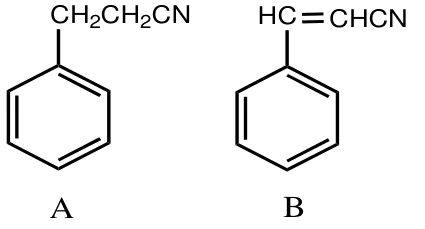
- (ii)A undergoes nitration predominantly at the ortho/ para positions but B mainly at meta position
- (c)Compare the basicity of:(5)
- (i)&
- (ii)&
- (iii)Aniline & Cyclohexyl amine
- (iv)
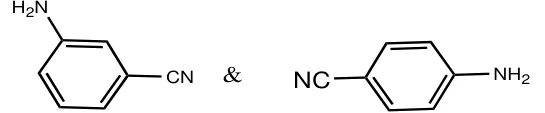
- (v)

- (d)Explain why? (2.5 each)(5)
- (i)Tertiary carbocation is more stable than primary.
- (ii)Ethanol has higher boiling point than diethyl ether.
- Q. 3(20)
- (a)Write the structural formula for more stable conformation of each of the following compounds.(8)
- (a)trans-1-Fluoro-3-methylcyclohexane,
- (b)cis-1-Iodo-4-methylcyclohexane
- (c)cis-1-tert-Butyl-4-methylcyclohexane,
- (d)cis-1,3,5-Trimethylcyclohexane
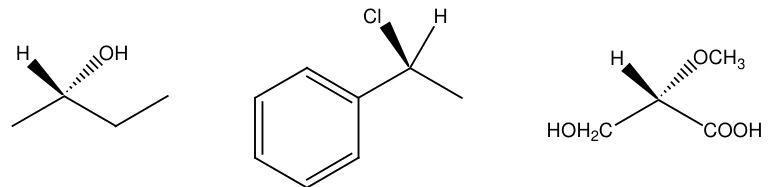
- (b)Mention R & S configuration of the following compounds.(5)
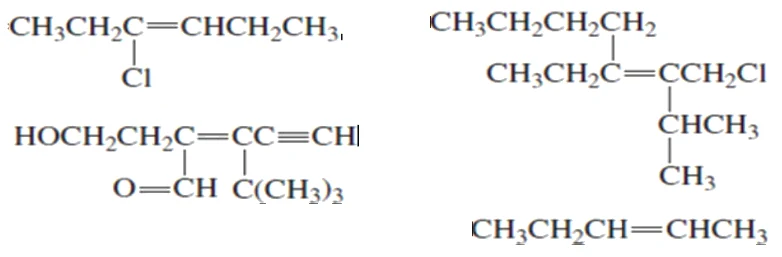
- (c)Draw and label the E and Z isomers for each of the following compounds.(5)
- (d)Draw the structure of (Z)-3-isopropyl-2-heptene.(2)
- Q. 4(4each)(20)
- (a)In benzaldehyde, two of the ring protons have resonance at 7.87 ppm, and the other three have resonance in the range from 7.5 to 7.6 ppm. Explain.
- (b)Arrange the following protons in the decreasing order of their δ values in 1H-NMR and account for your order: Methyl, ethylenic, acetylenic, aryl and aldehydic.
- (c)List the solvents most commonly used in IR spectroscopy. Why water and ethanol are not suitable solvents?
- (d)The UV spectrum of acetone shows absorption maxima at 166, 189, and 279 nm. What type of transition is responsible for each of these bands?
- (e)What types of electronic transitions are possible for each of the following compounds?
- (i)Cyclopentene,
- (ii)Acetaldehyde,
- (iii)Dimethyl ether,
- (iv)Methyl vinyl ether.
- Q. 5(10 each)(20)
- (a)Write down the reagents, conditions and mechanisms of the following reactions.
- (i)Kolbe reaction.
- (ii)Williamson synthesis
- (iii)Dow Process
- (iv)Reimer-Tiemann reaction
- (v)Bromination of phenol
- (b)Outline all steps involved in the synthesis of the following compounds from benzene or toluene, assuming that the ortho / para mixtures are separable.
- (i)n-Butylbenzene
- (ii)m-Nitrotoluene
- (iii)p- Bromonitrobenzene
- (iv)p- Bromobenzoic acid.
- (v)1,2-Dibromo-4-nitrobenzene
- Q. 6(20)
- (a)Describe with equations all possible methods that can be used for the preparation of n-hexane.(10)
- (b)Why Corey-House Method is more suitable as compared to Wurtz reaction for the synthesis of alkane. Explain with examples.(5)
- (c)Draw the structures of following compounds and label them with IUPAC systematic rules.(5)
- (i)3-cyclopentylhexane
- (ii)2-cyclobutyl-3-methylpentane
- (iii)Isopropylcyclodecane
- (iv)2-methylbicyclo [3.2.0] heptanes
- (v)8-methylbicyclo [3.2.1] octane
- Q. 7(20)
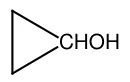
- (a)How can you prepare each of the following substances by a reaction involving Grignard reagent?(5)
- (i)
- (ii)
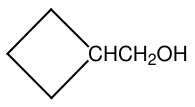
(Two ways)
- (iii)
- (iv)(Two ways)
- (v)(Three ways)
- (b)How will you bring about the following conversions?(5)
- (i)
- (ii)
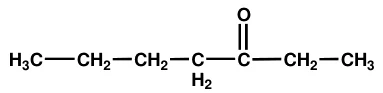
- (c)How would you synthesize each of the following compounds by the Reformatsky reaction?(5)
- (i)
- (ii)
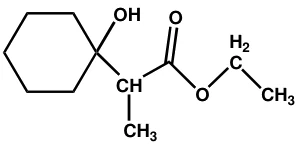
- (d)How would you synthesize each of the following compounds by the Wittig reaction?(2.5)
- (i)
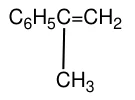
- (ii)
- (e)How will you synthesize each of the following substances by an actoacetic ester synthesis?(2.5)
- (i)3,4-dimethyl-2,5-hexanedione
- (ii)3-acetyl-5-hexanoic acid.
- Q. 8(20)
- (a)Discuss the following topics. (6 each)(12)
- (1)Prostaglandins
- (2)Terpenes
- (b)Name the epimers of d -glucose.(4)
- (c)Clearly represent the most stable conformation of the -pyranose form of each of the following sugars.(4)
A Greek letter (likely β) before '-pyranose' is missing in the printed paper.
- (a)D-Galactose
- (b)D-Mannose
- (c)L-Mannose
- (d)L-Ribose
- Part-II is to be attempted on the separate Answer Book.
- Attempt ONLY FOUR questions from PART-II. ALL questions carry EQUAL marks.
- All the parts (if any) of each Question must be attempted at one place instead of at different places.
- Candidate must write Q. No. in the Answer Book in accordance with Q. No. in the Q.Paper.
- No Page/Space be left blank between the answers. All the blank pages of Answer Book must be crossed.
- Extra attempt of any question or any part of the attempted question will not be considered.
- Use of calculator is allowed.