All Chemistry Paper II papers
CSS past paper
CSS Chemistry Paper II Past Paper 2021
CSS Chemistry Paper II 2021 carries 100 marks over 3 hours. It has 7 questions.
- Marks
- 100
- Time
- 3 hours
- Questions
- 7
How to attempt: Attempt ONLY FOUR questions from PART-II. ALL questions carry EQUAL marks.
Questions
Question 1 (Part I) is the paper's MCQs, which are not reproduced here.
- Q. 2(20)
- (a)Describe factors that influence keto-enol tautomerization. Elaborate the statement with the help of examples.(10)
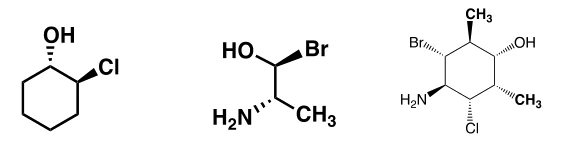
- (b)Assign “R” or “S” configuration on each of the chiral centers of the given compounds.(10)
- Q. 3(20)
- (a)Give the products expected (if any) when ethylbenzene reacts under following conditions: (02 marks each)(10)
- (i)in (dark)
- (ii),
- (iii)Conc.
- (iv)
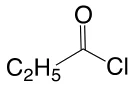
, (1.1 equiv.), then
- (v)Alkaline
- (b)Account for the following: (05 marks each)(10)
- (i)Intramolecular H-bonding is stronger than intermolecular H-bonding
- (ii)Control of nucleophilic substitution reaction over elimination reactions
- Q. 4(20)
- (a)Write down reagents, reaction conditions and important steps for the following conversions:(10)
- (i)Chlorobenzene to 2,4-dinitrophenyl hydrazine
- (ii)Pyridine to 2-amino pyridine
- (b)Write a note that substituents on aromatic rings dictate reactivity and orientation of the incoming electrophile in electrophilic aromatic substitution reactions.(10)
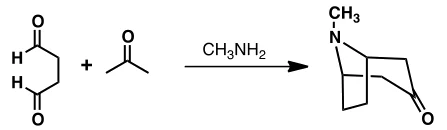
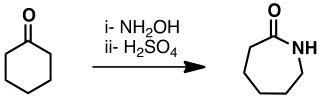
- Q. 5Draw detailed mechanisms for: (04 marks each)(20)
- (i)
- (ii)

- (iii)
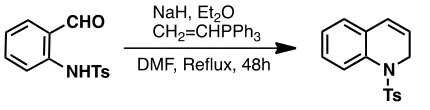
- (iv)

- (v)
- Q. 6Account for the following: (05 marks each)(20)
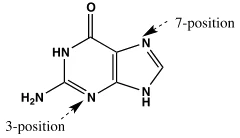
- (i)In DNA, a guanine residue reacts with electrophiles predominantly at the 7 and 3 positions of the ring system (see below). Suggest an explanation for this.
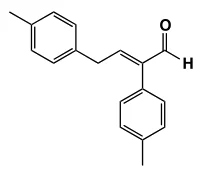
- (ii)Outline the synthesis of following compound:
- (iii)A Grignard reagent that is a key intermediate in an industrial synthesis of vitamin A can be synthesized in the following way:
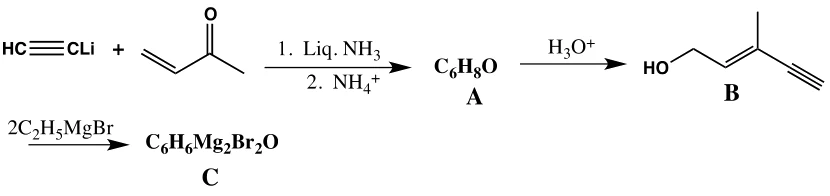
What are the structures of compounds A and C? The acid catalysed rearrangement of A to B takes p1.
- (iv)What are compounds A and B in the reaction given below? Compound B has a strong IR absorption band in the 1650–1730 cm region and a broad strong band in the 3200–3550 cm region.
- Q. 7Explain the following: (04 marks each)(20)
- (i)How can IR be used to help interpret NMR spectra?
- (ii)What are diastereotopic protons? Explain with examples.
- (iii)Determine the structure for a compound with formula with following H-NMR data:
δ 8.76 t (1H), 8.38 dd (2H), 7.97 t (1H)
- (iv)Assign chemical shifts of each proton in the above structure.
- (v)Why C-NMR is less sensitive than H-NMR?
- Q. 8Answer following questions: (04 marks each)(20)
- (i)Comment if glycogenesis is anabolic or catabolic. Write down all steps involve in glycogenesis.
- (ii)Describe endergonic and exergonic reactions
- (iii)Write a note on anionic and cationic surfactants.
- (iv)Comment if waste glass can be used for cement production.
- (v)What is the chemical composition of nucleic acids and their biological significance?
- Part-II is to be attempted on the separate Answer Book.
- Attempt ONLY FOUR questions from PART-II. ALL questions carry EQUAL marks.
- All the parts (if any) of each Question must be attempted at one place instead of at different places.
- Candidate must write Q. No. in the Answer Book in accordance with Q. No. in the Q.Paper.
- No Page/Space be left blank between the answers. All the blank pages of Answer Book must be crossed.
- Extra attempt of any question or any part of the attempted question will not be considered.