All Computer Science Paper I papers
CSS past paper
CSS Computer Science Paper I Past Paper 2023
CSS Computer Science Paper I 2023 carries 100 marks over 3 hours. It has 7 questions.
- Marks
- 100
- Time
- 3 hours
- Questions
- 7
How to attempt: Attempt ONLY FOUR questions from PART-II, by selecting TWO questions from EACH SECTION. ALL questions carry EQUAL marks.
Questions
Question 1 (Part I) is the paper's MCQs, which are not reproduced here.
SECTION-A
- Q. 2
- (a)Write a detailed note on any 03 Super Computing Technologies being used in the world. List key characteristics in each case.(8)
- (b)What performance metrics are used to analyze the capacity of Super Computers? Discuss.(6)
- (c)Discuss the role of Web Crawling, Indexing & Searching operations for a Search Engine.(6)
- Q. 3
- (a)How does dynamic memory allocation is managed programmatically in a C++ program? Clarify yours understanding through a viable program.(8)
- (b)Write a note on the use of overloaded operators. Discuss with examples.(6)
- (c)What is bit twiddling? Give brief description.(6)
- Q. 4
- (a)What is Polymorphism? Explain Ad-Hoc Polymorphism, Parametric Polymorphism & Subtyping with suitable coding examples.(8)
- (b)Discuss Late Binding with a short program.(6)
- (c)Differentiate between Abstraction & Encapsulation.(6)
SECTION-B
- Q. 5
- (a)For analyzing an Algorithm theoretically & asymptotically, give a detailed note on Input size, unit of time & order of growth. Support your answer with appropriate mathematical equations.(8)
- (b)Briefly describe the four types of analysis we may perform to evaluate the asymptotic behavior of an algorithm.(6)
- (c)Evaluate order of growth of the functions given below. Compare & write down which one has higher, same or lower order of growth than the other one:(6)
- (I)and
- (II)and
- (III)and
- (IV)and
- (V)and
- Q. 6
- (a)Discuss the architecture of aspect-oriented system.(8)
- (b)Briefly discuss the motivation for aspect-oriented programming.(6)
- (c)Briefly describe 05 agile software development frameworks.(6)
- Q. 7
- (a)Design and draw a finite automaton to recognize the regular language of all strings that contain the string ‘001’ as a substring.(8)
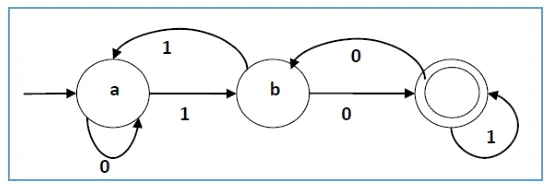
- (b)Consider the following state diagram and extract the standard information, i.e., Q, Σ, , F and δ.(6)
- (c)How would you optimize a loop? Describe the techniques briefly.(6)
- Q. 8
- (a)Discuss the role of Syntax Tree in representing formal text structure. Develop a Syntax Tree structure for the following piece of code:(8)
while b ≠ 0 if a > b a = a - b; else b = b - a; return a; - (b)Describe your understanding on Constant Folding using a brief pseudo code.(6)
- (c)What is an Optimization problem? What are its 02 general categories? Write down mathematical representation of a standard optimization problem.(6)
- Part-II is to be attempted on the separate Answer Book.
- Attempt ONLY FOUR questions from PART-II, by selecting TWO questions from EACH SECTION. ALL questions carry EQUAL marks.
- All the parts (if any) of each Question must be attempted at one place instead of at different places.
- Write Q. No. in the Answer Book in accordance with Q. No. in the Q.Paper.
- No Page/Space be left blank between the answers. All the blank pages of Answer Book must be crossed.
- Extra attempt of any question or any part of the question will not be considered.